
Clinton County Wanted Notice Status
Sheriff Ricky Marcum's office has no standing most-wanted page. There is no public warrant portal. No entry count, publication schedule, or permanent tip form either. The official sheriff resources page connects visitors to state and victim services, yet a wanted roster is missing from it. That gap matters. A search-engine result can look like a live sheriff list when it is nothing of the sort.
Two timing traps deserve attention. First, a person can hold an active warrant while appearing in no public notice. Second, an old notice can linger in search indexes long after a warrant was served, recalled, or closed. Status questions belong with the court or law-enforcement office that keeps the record.
Clinton County's Episodic Alerts
What Clinton County does have is an episodic alert system. One example stands out. A June 2, 2026 WKYT report carried a Sheriff Ricky Marcum update on a person wanted in another state's homicide investigation. The story flagged the man as possibly armed and dangerous. It urged readers not to approach him. Tips went to named agencies or 911.
WKYT also ran an agency-supplied identification image. That photo stays with the station and the issuing agency, tied to one dated safety event. It hardly proves the county runs a photo-bearing list. The Tennessee Bureau of Investigation reward mentioned in the piece applied to that notice alone, not to any ongoing county program.
The manifest capture below keeps the notice's layout and safety context intact. It does not turn a single report into a local gallery. For the current wording, read the original WKYT wanted report at the source.
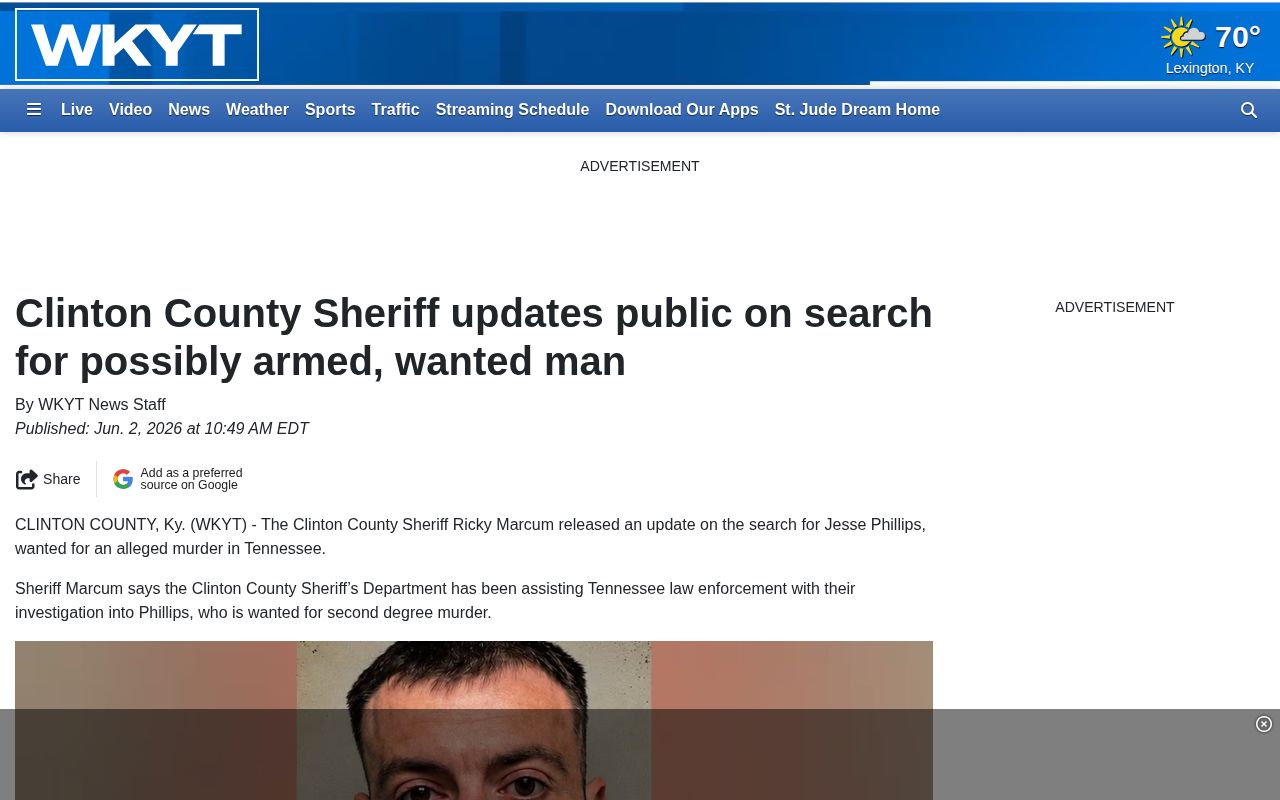
Always confirm a dated report at its source. Safety instructions and wanted status can shift after publication.
Note: A news alert is a dated distribution channel, not a complete warrant index or proof that a person remains wanted.
Fields a Verified Notice Needs
With no standing county list to describe, these fields serve as verification tools rather than descriptions of a live portal. Each one helps separate an official, current notice from a recycled post or a case of mistaken identity.
| Field | What to verify |
|---|---|
| Issuing agency | The sheriff, court, KSP, or outside agency responsible for the notice |
| Notice date | When the alert was issued or last updated |
| Case or warrant reference | A public identifier, if the agency releases one |
| Alleged basis | The charge stated by the agency, never phrased as guilt |
| Image source | The agency or publisher that supplied the identification image |
| Safety and tip route | The exact warning and contact printed in that specific notice |
| Current status | Confirmation from the court or responsible law-enforcement office |
Read Clinton County Wanted Alerts
A dated alert earns trust only when its agency, place, and status check out. Use this short process whenever a Clinton County wanted-fugitive item surfaces in search results or social media.
- Open the original source. Prefer the sheriff, KSP, court, or the named publisher instead of a copied post.
- Check the date and jurisdiction. Confirm that Clinton County, Kentucky is involved and note whether another state or county issued the warrant.
- Read the safety language. Do not approach. Use only the agency contacts printed in the active notice.
- Confirm before relying on it. Ask the responsible office whether the notice is current, resolved, recalled, or restricted.
- Keep the record states separate. A later booking may appear through the Clinton County arrest and custody routes, but booking does not prove guilt.
A screenshot is not a status report. Neither is a shared image or an old headline. What matters most is whether the notice is still live, and only the issuing office can say that. So hold off on spreading a face as current just because the original posting never came down.
Check a Clinton County Warrant
Clinton County has no verified warrant-search page of its own. So the search folds into other channels. One option is the Kentucky Court of Justice case tools. Court dockets can hint at trouble. CourtNet, though, was never meant to confirm live warrant status. For that, call the sheriff. The Clinton Circuit Court Clerk keeps the court files and can point you to a specific case record.
- Search for the related case. Use Kentucky's Find a Case or CourtNet tools to locate public case information.
- Ask the clerk about the file. Call the Clinton Circuit Court Clerk at (606) 387-6424 or (606) 387-8181 for record location and copy questions.
- Confirm current law-enforcement status. Call the Clinton County Sheriff at (606) 387-5111 and ask for the office that maintains the relevant record.
- Separate custody from warrant status. Contact County Jailer Tracy Thurman at (606) 387-7395 when the question is whether someone is currently held.
- Resolve an own warrant safely. Contact an attorney or the court for advice on appearance and resolution. Do not rely on a commercial search page.
These channels answer different questions. A court case may exist while a person is out of custody, and a jail contact may confirm custody without deciding the final court outcome.
Clinton County Warrant Record Types
Not every document called a warrant serves the same function. The record holder and public-access limits depend on the document and whether it has been executed, sealed, or restricted.
| Type | Meaning and responsible check |
|---|---|
| Arrest warrant | A judicial order authorizing arrest; confirm current status with the court or sheriff. |
| Bench warrant | A court-issued order often connected to a pending case or required appearance; contact the clerk or counsel. |
| Search warrant | Authority to search a place or property, not a public list of wanted people. |
| Executed warrant copy | A record that may be public unless a court seal or other restriction applies. |
The Kentucky Court of Justice Clerk's Manual says search-warrant requests route through the county or commonwealth attorney. That records process must not be confused with checking whether a person faces an active arrest warrant.
An executed copy and an active-status check also answer different needs. A copy may show what a judge authorized and when officers carried it out, subject to sealing or other limits. It does not, by itself, establish whether another warrant exists. The clerk can help locate the court record, while the sheriff can route a present law-enforcement inquiry. Neither channel should be replaced with an index that promises instant results without naming its source.
When a record is restricted, the absence of public detail should be respected. Juvenile matters, sealed files, active investigations, and safety concerns can limit access. Do not fill those gaps with a name, address, photograph, or physical description copied from an unofficial page. A narrow request for an existing, identified record is more reliable than a broad demand for every person who may be wanted.
Clinton County Tip Contacts
No verified Clinton County anonymous tipline, Crime Stoppers program, blanket anonymity policy, or standing reward schedule was found. Do not assume a caller is anonymous and do not promise payment. Follow the exact contact and reward terms of the current notice.
Clinton County Sheriff's OfficeRicky Marcum, Sheriff
100 South Cross Street
Albany, KY 42602
Phone: (606) 387-5111
Emergency: 911
Consider the 2026 WKYT case. Tips there went to TBI, the Pickett County Sheriff's Office, or KSP Post 15, because the investigation itself stretched across state lines and jurisdictions. That routing fit that one notice. It does not carry over to an unrelated Clinton County alert, so check which office actually issued it before calling anyone.
Note: Report facts, place, and time to law enforcement rather than confronting anyone or streaming live movements onto social media.
Resolve Clinton County Status Safely
Kentucky splits criminal work between two courts. District Court takes arraignments, misdemeanors, traffic matters, and the probable-cause stage of felonies, while Circuit Court handles felony jurisdiction and everything that follows.
Worried about your own warrant? Call a lawyer or the court clerk. Do not show up at a scene or try to test a warrant through an encounter. Skip any unofficial payment page offering quick fixes. Court staff can explain how to get records but cannot give legal advice; counsel can advise you on appearing safely and protecting your rights.
After an arrest, the record moves through distinct stages: booking, arraignment or probable-cause review, later disposition, then custody or release. Each stage has its own source and date. The Clinton County Jail answers custody questions but does not replace the court file. CourtNet shows public case information without promising a live jail or warrant result. Keeping those limits straight keeps an old alert from being mistaken for current fact.
No Permanent Sheriff Alert Feed
The sheriff's official resources page offers no standing alert feed. There is no mobile app. No booking-alert service, roster API, emailed warrant list, or permanent social channel for wanted fugitives. A social account with a similar name cannot be tied to a stable URL through county pages. Treat it as unverified.
VINE is the one notification tool the sheriff links. It covers custody and release updates only. It is not a warrant portal, a wanted list, or a photo database. Results hinge on whether an agency participates and how fast data gets entered. Kentucky users can search by name or jail/DOC number, or call (800) 511-1670.
KSP keeps an official news archive, and local publishers push alerts through their own sites. Both channels are episodic. A post may skip a later correction or a release. The issuing agency and the court record still control what is true.
Silence teaches you nothing here. Someone missing from the sheriff's page is not cleared. Someone named in an old broadcast may no longer be wanted. The question is which office issued the process and whether that office still confirms it. Search results can point to a source, but they never settle final status.